Example Output
This page collects representative TransitionListener output from published applications and from the shipped grid-scan example.
Published applications
TransitionListener has already been used in several dark sector and gravitational wave studies:
Turn up the volume: listening to phase transitions in hot dark sectors
arXiv: 2109.06208, JCAP 02 (2022) 014.
This work introduced the original TransitionListener workflow for a dark Abelian Higgs model and used it to compute phase-transition dynamics, dilution effects, and the resulting gravitational wave signal for hot dark sectors.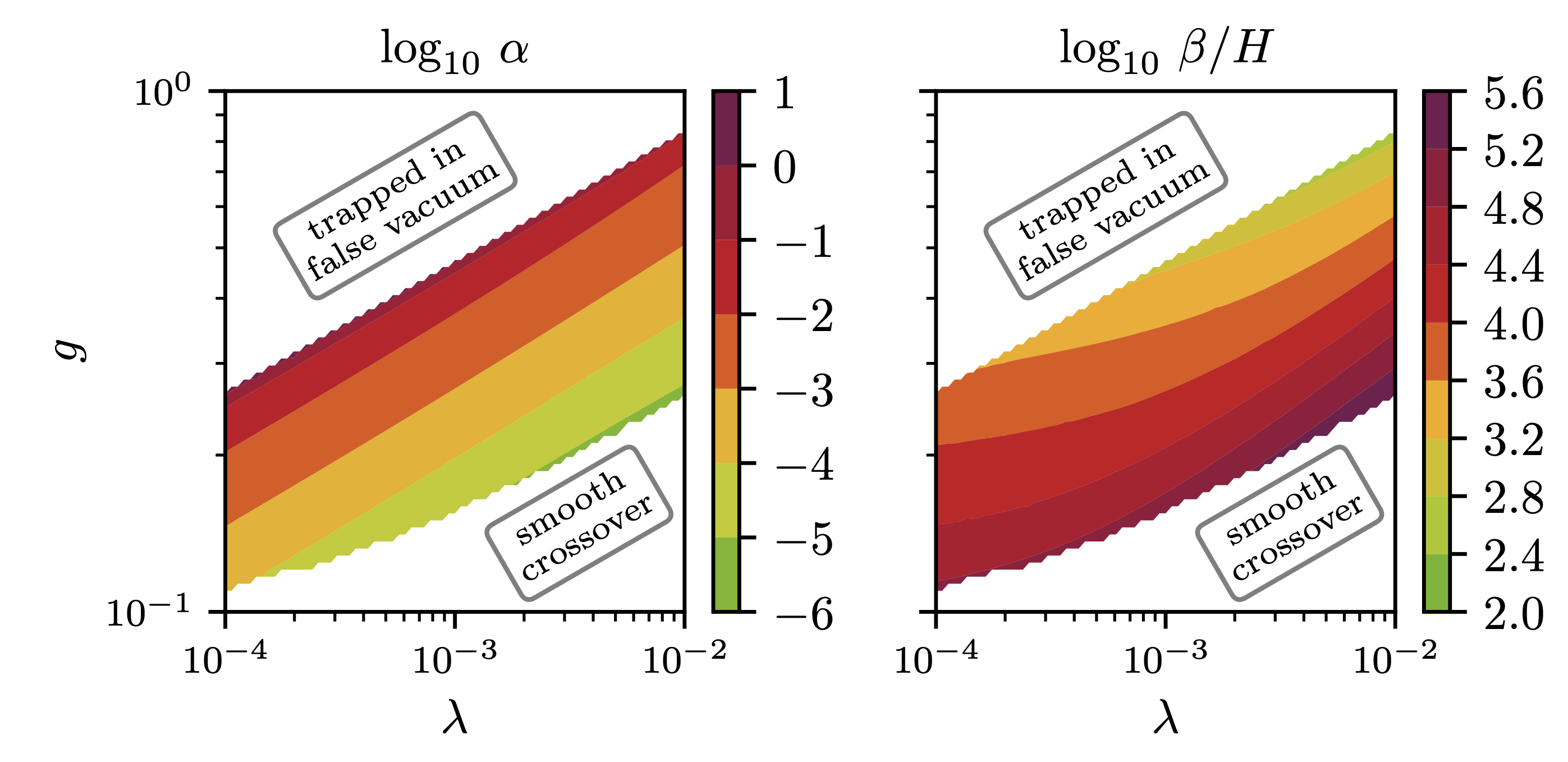
Hunting WIMPs with LISA: correlating dark matter and gravitational wave signals
arXiv: 2311.06346, JCAP 05 (2024) 065.
Here TransitionListener was used to map the phase-transition and gravitational wave predictions of a dark \(U(1)^\prime\) model onto the relic-density requirement, exposing the correlation between dark matter freeze-out and the milli-Hertz gravitational wave signal.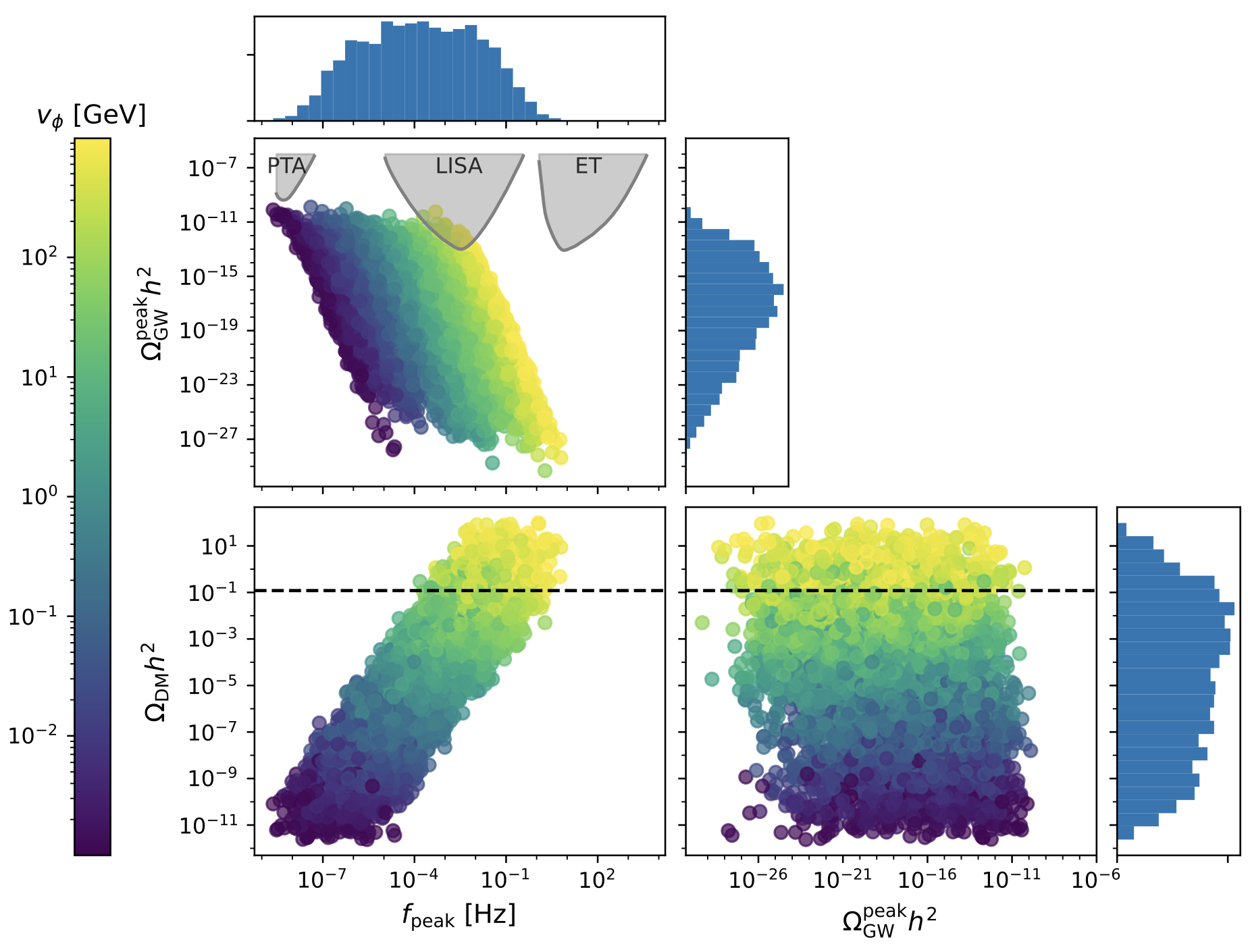
Sub-GeV dark matter and nano-Hertz gravitational waves from a classically conformal dark sector
arXiv: 2502.19478, JCAP 08 (2025) 062.
In this project TransitionListener was applied to a classically conformal dark \(U(1)^\prime\) model in order to identify parameter regions that simultaneously yield a PTA-scale gravitational wave signal, the observed dark matter abundance, and consistency with laboratory and cosmological constraints.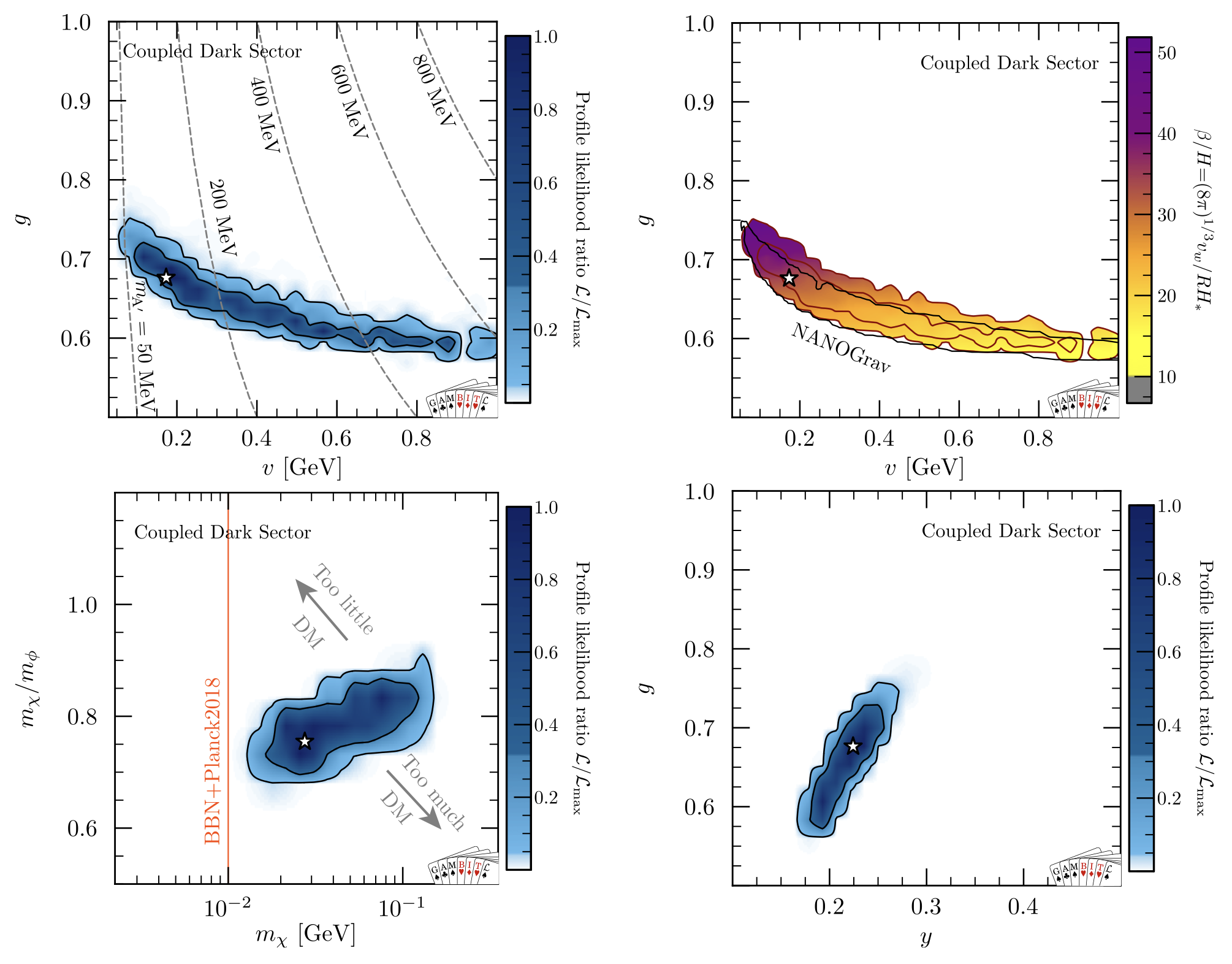
Tuning the violins: dark sector phase transition models for the PTA signal
arXiv: 2602.09092.
This study used TransitionListener random scans and its UltraNest/PTA-likelihood interface to compare several dark-sector model classes and quantify how much tuning is required to explain the PTA signal.
The following figure is the \(\alpha\)–\((\beta/H)_{RH}\) comparison plot discussed in the TransitionListener v2 paper and attributed there to the last study above:
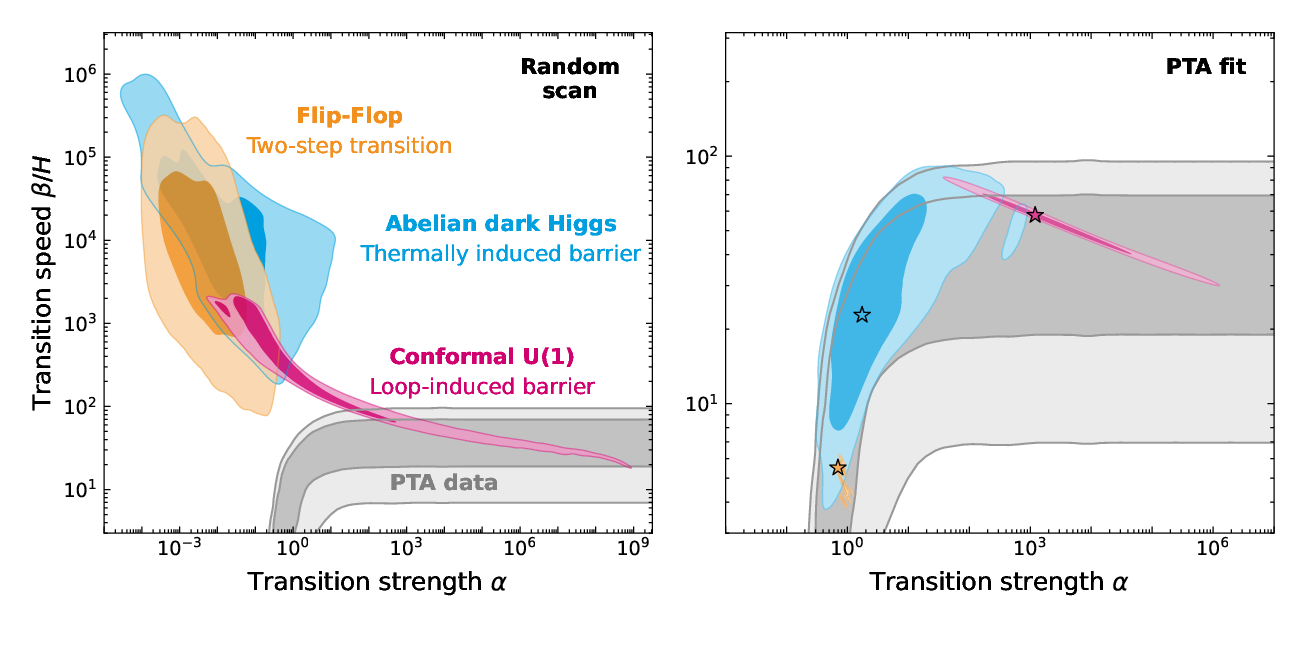
It compares three dark-sector model classes in the \(\alpha\)–\((\beta/H)_{RH}\) plane. The left panel shows generic model predictions from TransitionListener random scans, while the right panel shows the regions favored by PTA-informed nested sampling with the UltraNest backend.
Reproducing the shipped grid scan
The gallery below is generated from the example configuration
examples/example_grid.yaml, which runs a grid scan of the Abelian dark Higgs
model implemented in models/TL_dark_U1.py.
The scan settings are:
x-axis parameter:
lon a logarithmic grid from \(10^{-4}\) to \(10^{-2}\)y-axis parameter:
v_GeVon a logarithmic grid from \(10^{6}\) to \(10^{10}\) GeVfixed input:
g_tilde = 2.69precision preset:
benchmarkgrid size:
10 x 10
Run it with:
tl -c examples/example_grid.yaml -j 10
The produced plots in scans/example_grid/ are then copied into the docs as
PNG files for the gallery below.
Transition strength and milestone temperatures
These panels summarize how the transition strength and the characteristic temperatures vary across the two-dimensional parameter grid.
|
|
|
|
|
|
|
|
|
|
|
|
|
|
|


Plasma and thermodynamic quantities
These plots expose the background-fluid quantities that enter the time-temperature relation and the macroscopic transition observables.
|
|
|
|
|
|
|
|


Peak gravitational wave observables
These panels show the peak frequency and peak amplitude of the predicted gravitational wave spectrum across the scan.
|
|
|
|


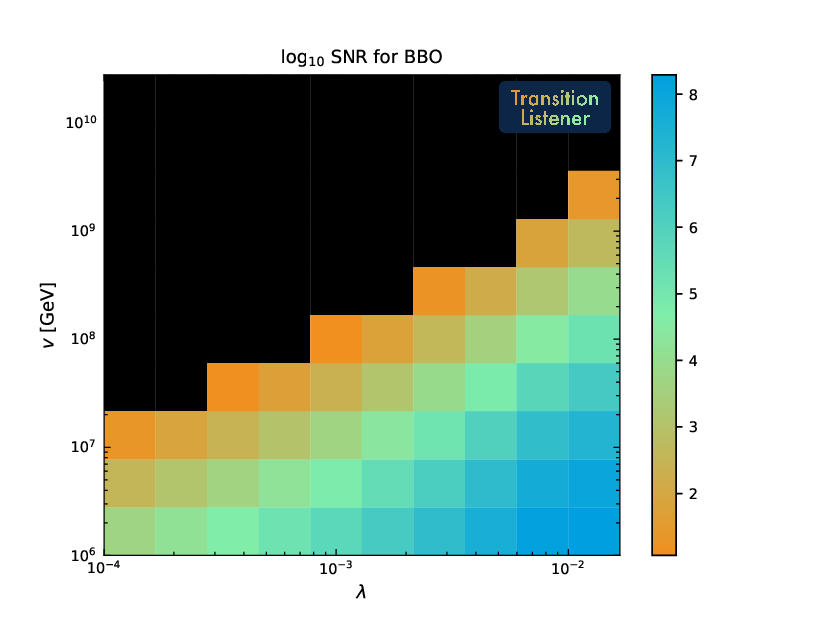
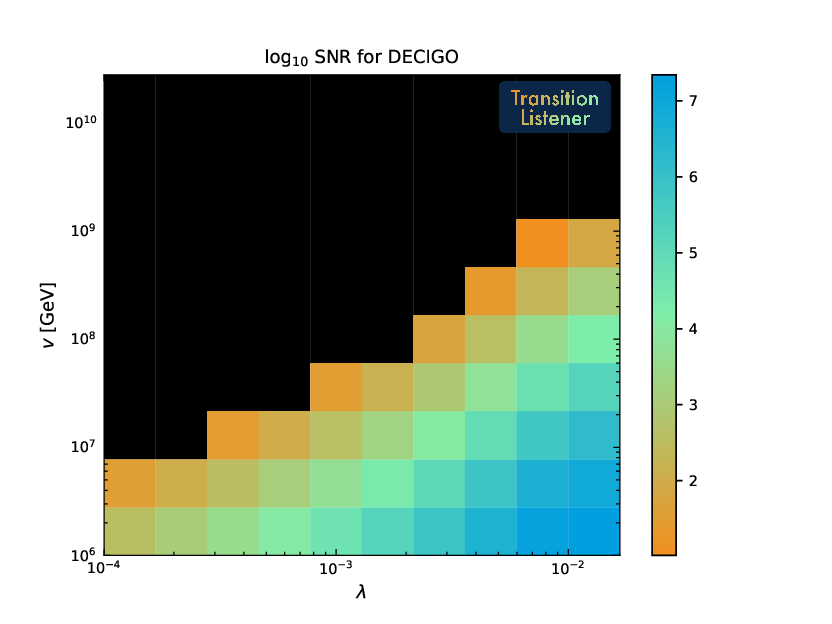
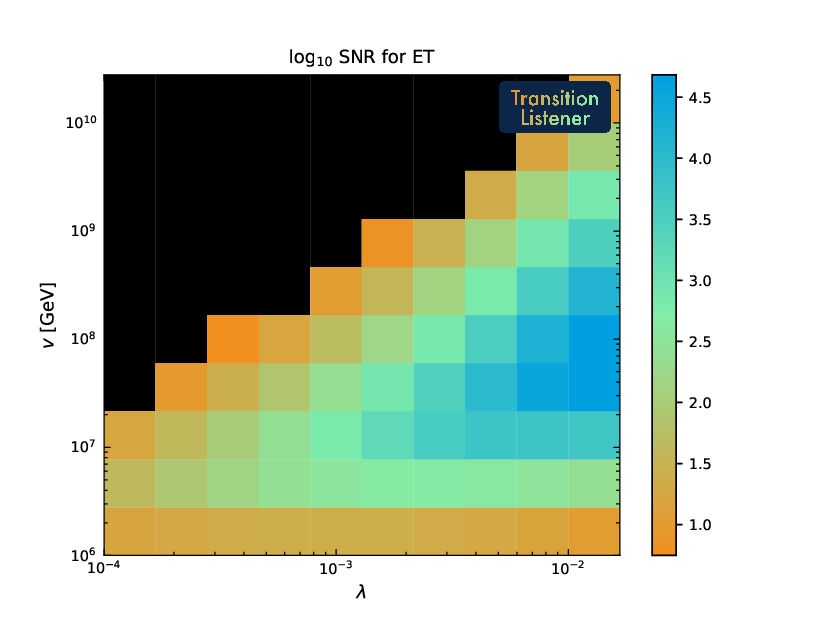
Detector signal-to-noise maps
The final group illustrates how the predicted signals map into the signal-to-noise ratios of selected future detectors.
|
|
|
|
|
|